Omnisend vs Constant Contact is a choice between an ecommerce automation platform and a simple email tool for small organizations. Pick Omnisend if you run an online store and want cart recovery, SMS, and behavior-based flows, even on the free plan. Pick Constant Contact if you send newsletters, run events, or serve a local community and want the easiest setup. A good pick matches how you actually sell, not how many features a pricing page lists.
The problem is that both tools call themselves email marketing software, and their homepages look alike. The real gaps show up later, when you try to build a post-purchase flow, text a customer, or find out which campaign produced an order. By then you have already imported your list and paid for a plan.
We manage email and SMS programs for ecommerce brands at Chromex Marketing, and we are an official Omnisend partner. That means we see both sides of this decision. Below, we compare the two tools on five factors, then show which kind of business should choose which. Where Constant Contact is the better fit, we say so.
1. Pricing and free plan
Omnisend costs less to start with because it has a permanent free plan, while Constant Contact only offers a free trial. In the omnisend vs constant contact pricing question, both bills rise as your list grows, so compare plans at the list size you expect in a year, not at the entry price.
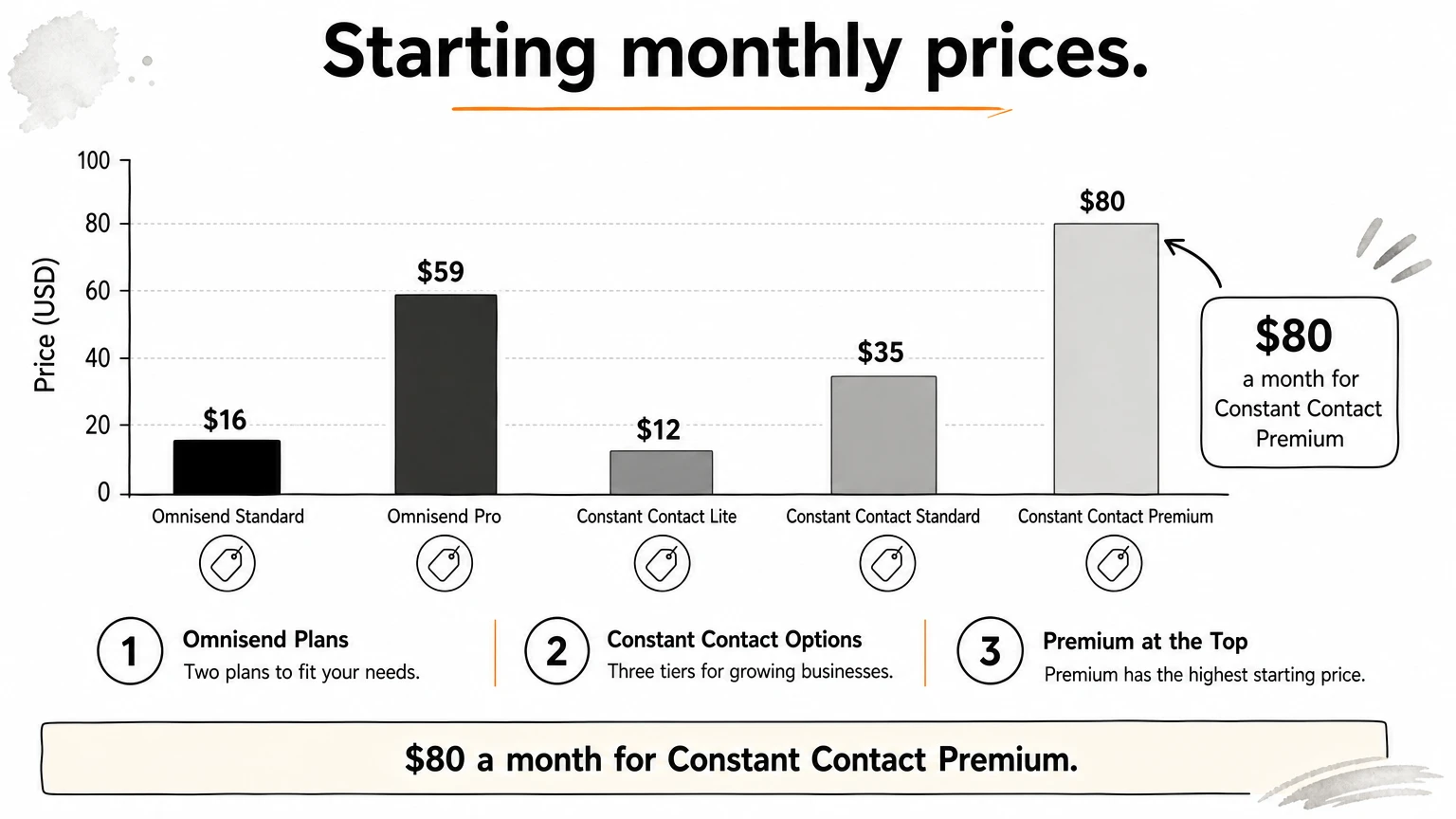
A free plan with full automation beats a trial that ends after a month.
How Omnisend prices its plans
Omnisend has three tiers. The Free plan supports a small list and still includes automation, segmentation, reporting, and A/B testing. Standard starts at $16 a month, and Pro starts at $59 a month with bonus SMS credits and advanced reporting.
Spending matters too. Accounts that reach $400 a month in spend get a dedicated account expert. SMS is paid for through credits, so budget for texting separately from your plan fee.
How Constant Contact prices its plans
Constant Contact sells Lite, Standard, and Premium plans, starting at roughly $12, $35, and $80 a month. The catch is feature gating. The Lite plan automates only a welcome email, so most buyers who want more automation or segmentation end up on a higher tier.
Here is how the two compare at the starting level. Prices are monthly and climb with your contact count, so confirm current figures on each pricing page before you buy.
Omnisend | Constant Contact | |
|---|---|---|
Free option | Free plan | Free trial only |
Paid tiers, starting price | Standard $16, Pro $59 | Lite $12, Standard $35, Premium $80 |
Automation on the lowest plan | Full automation on every plan | Welcome email only on Lite |
Price as your list grows | Rises with contacts | Rises with contacts |
2. Marketing automation
Omnisend has the stronger marketing automation, and it is not close. Constant Contact covers basics like welcome and birthday emails, but branching logic and cross-channel workflows belong to Omnisend. Automation also drives store revenue: Omnisend's 2023 report found that automated emails produced 41% of email sales from only 2% of sends.
Automation depth is the biggest gap between these two tools.
What Omnisend automates
Omnisend ships pre-built workflows you can switch on right away, and a visual editor for building your own. The library covers the flows an online store needs. All of it works on every plan, including the free one.
Welcome series
Browse abandonment and cart abandonment
Post-purchase and product follow-ups
Reactivation for lapsed buyers
Conditional splits, conditional content, and A/B tests inside a flow
Email, SMS, and web push steps in the same workflow
What Constant Contact automates
Constant Contact offers a fixed menu of automations. Some of them work only with certain stores, and the fuller set sits above the Lite plan.
Welcome email or series
Birthday and anniversary emails
Cart abandonment email or series (Shopify, Wix, WooCommerce)
Order placed and fulfilled emails (Shopify, Wix, WooCommerce, Squarespace)
Custom email series
That is enough for a local shop or a nonprofit. It is thin for a store that wants flows split by purchase history, which is where most of the revenue sits.
3. Email builder and ease of use
Constant Contact is easier to learn, and Omnisend is better at selling products inside the email. The right answer in the omnisend vs constant contact debate depends on whether you sell products or mostly send updates.
Simple wins for newsletters, product-aware wins for stores.
How Omnisend's builder works
Omnisend's drag-and-drop editor is built around your catalog. The product picker pulls items, prices, and images straight from your store, and auto-branding imports your logo, colors, and fonts, which saves design time on a new account.
Testing goes further than subject lines. You can test content and send timing, and you can split-test inside automations. The tradeoff is a little more to configure at first, and some features need a connected store.
How Constant Contact's builder works
Constant Contact uses a drag-and-drop editor with mobile-responsive templates and AI writing help. Setup is quick and the learning curve is gentle, which is why beginners like it.
Its A/B testing mostly covers subject lines, and its templates lean toward newsletters and announcements rather than shoppable product grids. If your emails are mostly text, photos, and event details, you will not miss product blocks.
4. SMS, channels, and ecommerce reporting
Omnisend is the better ecommerce platform because email, SMS, and web push run in one workflow tied to store data. Constant Contact also reaches beyond email, but through social posting, events, and surveys rather than store-triggered messaging. For a store, that makes omnisend vs constant contact a question of revenue visibility.

Omnisend tells you which message produced an order. Constant Contact tells you who opened it.
Omnisend's channels and store data
Omnisend connects natively with Shopify, WooCommerce, and BigCommerce, syncing customers, orders, and products in real time. That sync powers the rest of the platform:
Segments built from purchase behavior and browsing
SMS delivered globally, inside the same workflows as email
Web push for abandoned carts, restocks, and new arrivals
Sales reports with revenue attribution by campaign and automation
Constant Contact's channels and tools
Constant Contact works as a broader small-business toolkit. Its reporting centers on opens, clicks, and engagement trends, not on store revenue. It has no web push, and its SMS is offered on higher-tier plans and is aimed at US audiences.
Event registration, ticketing, and attendee tracking
Surveys and polls for customer feedback
Scheduled posts to major social networks
SMS on higher plans
5. Signup forms and customer support
Both tools capture subscribers well, but Omnisend gives you more list-building options on every plan and support around the clock. Constant Contact's advantage is phone support. In the omnisend vs constant contact comparison, list growth and help when stuck are the two areas new senders underestimate.
Good support is cheapest to find before you need it.
Omnisend's forms and support
Omnisend includes landing pages, in-line forms, and popups, with exit-intent and time-triggered versions, even on the free plan. Multi-step popups collect more data in one go, and the Wheel of Fortune form turns a discount into a game that tends to lift signups.
Support runs 24/7 by live chat and email on every plan. The company reports average response times under four minutes, and larger accounts get a dedicated expert to help them with campaigns.
Constant Contact's forms and support
Constant Contact offers signup forms, landing pages, and popups. That is enough to grow a basic list from a website or an event sign-in sheet, though the design and targeting options are simpler than Omnisend's.
Support is its traditional strength. You get live chat and phone support during business hours, which is reassuring if you are new to email marketing. Hours are limited, so an evening or weekend problem may wait until the next business day.
Which one fits your business
Choose Omnisend if you sell products online, and choose Constant Contact if you mainly send newsletters, event invitations, and community updates. If you are on the fence, ask one question: do your emails need to react to what a shopper did, or do they follow a calendar?
If your emails react to shopper behavior, pick Omnisend. If they follow a calendar, Constant Contact is enough.
Choose Omnisend if
Omnisend suits any business whose revenue comes from a catalog. Look for these signs:
You run a Shopify, WooCommerce, or BigCommerce store
You want cart abandonment, browse abandonment, and post-purchase flows live this week
You plan to add SMS or web push
You want revenue tracked by campaign
You want advanced automation without paying for a higher tier
Setup is where many stores stall. Chromex Marketing is an official Omnisend partner, and sign-ups through the Chromex link get 20% off the first two months, offered as cashback.
Choose Constant Contact if
Constant Contact suits organizations that communicate more than they sell. Look for these signs:
You send a regular newsletter or announcement on a set schedule
You run events and want registration inside your email tool
You are a nonprofit, local service business, or solo operator
One person runs everything and wants phone support
Your list is small and you do not need behavior-based flows
Is Constant Contact outdated, and what else is there?
Constant Contact is not outdated. It is a mature tool that keeps adding features such as AI writing help and SMS, but it is built for simplicity, not ecommerce depth. If you outgrow it, Omnisend is the usual step for stores, and Klaviyo is the other platform ecommerce brands shortlist.
As for whether Omnisend is any good, for a store the answer is yes. Its free plan alone includes automation, segmentation, and A/B testing, which makes it hard to beat when you are starting out.
Match the tool to how you sell
Omnisend wins on automation, SMS, store data, and price at the low end, which makes it the right default for ecommerce. Constant Contact wins on simplicity, events, and phone support, which makes it the right default for newsletters and local organizations. Neither choice is wrong. Using the wrong one for your business model is what costs you.
Whichever you choose, the tool only pays off once the flows, forms, and campaigns are built well. If you run an online store and want that done for you, Chromex Marketing is an ecommerce email marketing agency that manages email and SMS programs on Omnisend and Klaviyo, so you can book a call and see what your list should be earning.