The best email marketing software for ecommerce syncs your store data in real time, runs abandoned cart and post-purchase flows off shopper behavior, and reports revenue instead of just opens. Omnisend suits most growing stores that want email and SMS at a fair price. Klaviyo fits data-heavy Shopify brands, Drip suits revenue-focused stores, and ActiveCampaign suits teams that live inside automations. Mailchimp, MailerLite, Brevo, and Shopify Email cover tighter budgets, while GetResponse and HubSpot fit stores that need webinars or a full CRM.
Picking from dozens of platforms is hard because every vendor claims the same features. The real differences sit in how deeply each tool reads your store data, how it bills you as your list grows, and which automations come ready to use. This guide compares ten platforms on those points, with pricing ranges, integrations, strengths, and trade-offs, so you can shortlist two or three and test them.
At Chromex Marketing, we run email and SMS programs for ecommerce brands every day, mostly in Klaviyo and Omnisend. That hands-on work shapes the opinions below. A tool alone rarely makes email a major revenue channel, but the wrong tool will cap it. That is why this choice deserves a careful look before you migrate a single subscriber.
What to look for in ecommerce email marketing software
Good ecommerce email software does three things well: it reads your store data accurately, it automates around shopper behavior, and it bills you in a way that stays sane as your list grows. Everything else is secondary. Use the checks below on every tool in this list, and on any tool we do not cover.
Features that drive revenue
Start with automation, because flows produce most of the revenue a store earns from email. At minimum you need a welcome series, abandoned cart, browse abandonment, post-purchase, and winback. Check that the trigger library covers store events such as back in stock, and that you can split paths based on purchase history.
Beyond flows, these features separate store-ready tools from newsletter tools:
Segmentation on order count, total spend, product category, and last purchase date
Product blocks and dynamic recommendations inside emails
Revenue attribution at the campaign and flow level
SMS and push notifications inside the same automations
A/B testing for subject lines, content, and signup forms
How pricing models change your bill
Platforms charge in three ways. Some bill on total contacts or profiles, including inactive ones. Klaviyo bills on active profiles, and Mailchimp counts unsubscribed contacts. Others bill on send volume, as Brevo does. A few, like Drip, include every feature on every plan and scale only with list size.
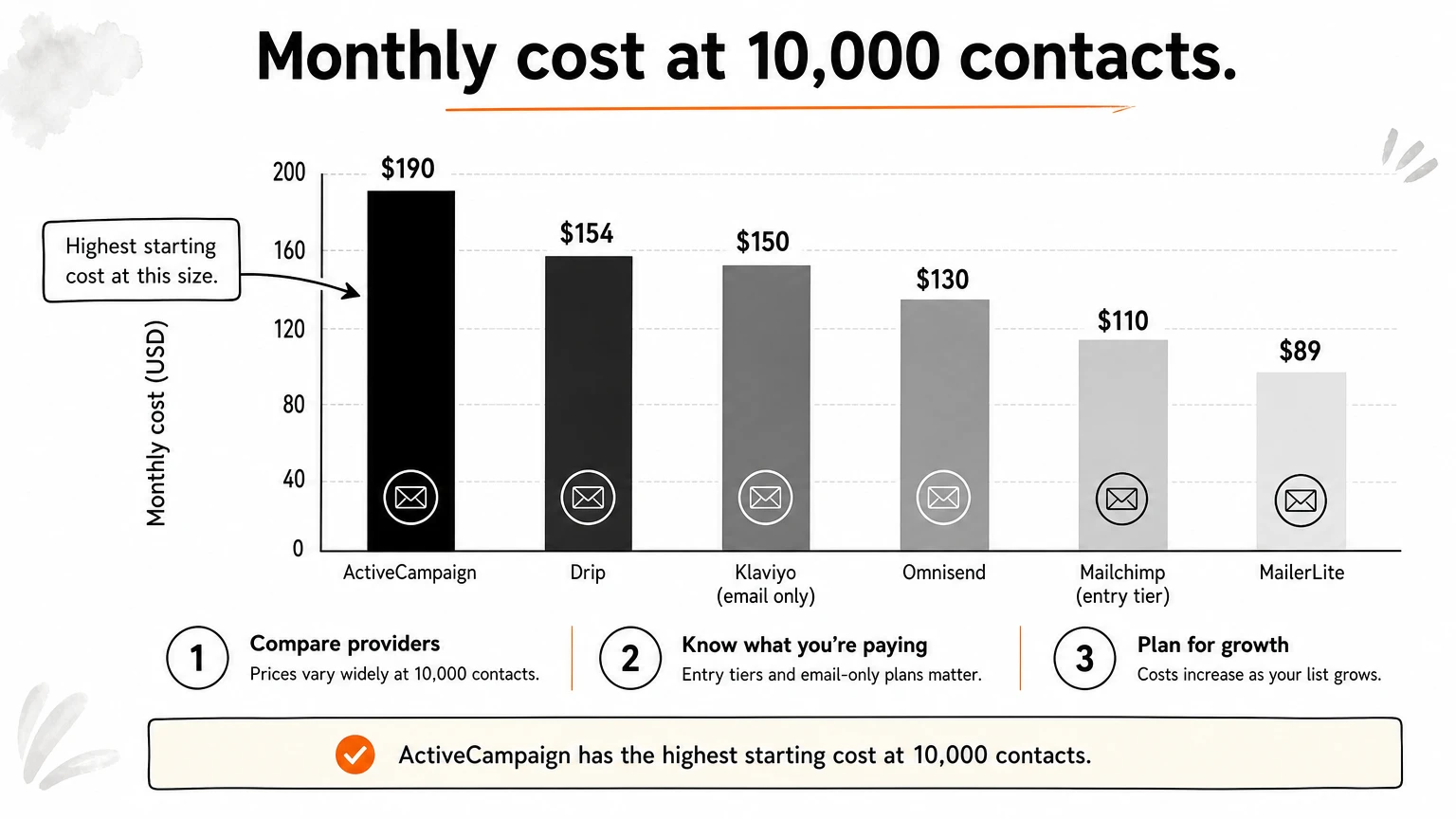
Model your bill at 5,000 and 20,000 contacts, not at today's list size. A tool that costs $20 a month now can cost several times more after one strong quarter of list growth. Also confirm which features sit behind higher tiers, because SMS, advanced automation, and revenue reports are the usual upsells.
The price on the pricing page is the start of the bill, not the end of it.
Integrations and data sync
Native integrations with Shopify, WooCommerce, and BigCommerce are standard now, but sync quality varies widely. A shallow connection passes names and emails. A deep one passes products, variants, orders, discount codes, and browsing events, which is what powers real personalization.
During any free trial, test these five things before you commit:
Historical orders import when you connect the store
A test abandoned cart triggers the right email with the right product
Product variants and images display correctly in emails
Discount codes generated in the tool work at checkout
Consent and unsubscribe status stay in sync with the store
1. Omnisend
Omnisend is the best all-round pick for most small and mid-size stores that want email, SMS, and push in one place without Klaviyo-level pricing. As email marketing software for ecommerce, it ships with the parts a store needs on day one.
Features and integrations
Omnisend connects to Shopify, BigCommerce, WooCommerce, and other major store platforms, and it pulls in product, order, and browsing data for segmentation. Its pre-built workflows for welcome series, abandoned cart, and post-purchase launch in a couple of clicks. You can still build custom automations with conditions and splits when you need them.
Email, SMS, and web push inside the same automation
350+ templates that lean toward product promotion
Product blocks, discount codes, and signup forms with ecommerce logic built in
A Customer Lifecycle Map that shows where shoppers sit and what to send next
Pricing and limits
The free plan covers 250 contacts and 500 emails a month, which is enough to test the tool on a young store. Paid plans start around $16 per month for 500 contacts and scale with list size. At 10,000 contacts, expect roughly $130 per month for the email tier.
SMS access depends on your plan, so confirm which tier includes texting before you commit. Chromex is an official Omnisend partner, and sign-ups made through Chromex get 20% off the first two months, offered as cashback.
Who it suits and where it falls short
Omnisend suits growing Shopify and WooCommerce stores that want multichannel flows at a reasonable price. It is a strong first platform and a solid long-term one for stores that do not need predictive modeling.
Omnisend gives you the most ecommerce firepower per dollar for a store under roughly 50,000 contacts.
Its limits are depth rather than basics. Some advanced reports refresh daily instead of in real time, and its free plan is tighter than it used to be. Very data-heavy brands may eventually want Klaviyo's analytics.
2. Klaviyo
Klaviyo is the strongest choice for data-heavy brands, especially on Shopify, that want deep segmentation, predictive analytics, and a large app ecosystem. It is the platform most ecommerce agencies, ours included, know inside out.
Features and integrations
Klaviyo's Shopify integration is among the deepest available, and Shopify has named it a preferred email partner for Shopify Plus merchants. Its flows are powerful for ecommerce, and its segmentation lets you build audiences from nearly any behavior or purchase attribute. A built-in customer data platform combines data from several sources into one profile.
Predictive analytics, including estimates of when a customer may buy again
A/B testing for emails and signup forms
Dynamic product recommendations inside emails
SMS built into the same flows as email
Industry benchmarks so you can compare your results to peers
Pricing and limits
Klaviyo has a free plan for up to 250 profiles and 500 emails. Paid plans start around $20 per month for 251 to 500 profiles and bill on active profiles, so every contactable profile counts whether you email it or not. For email only, expect roughly $100 per month at 5,000 profiles and about $150 at 10,000. SMS and add-ons bill on top.
Who it suits and where it falls short
Klaviyo fits established stores with a real list, a real catalog, and someone who will use the data. If you plan to segment on lifecycle stage, predicted value, and product affinity, it rewards the effort.
Klaviyo is the tool to pick when your limiting factor is data, not budget.
The trade-offs are cost and complexity. Each flow accepts a single entry trigger, so a flow that should start in two ways needs a duplicate. Many pre-built flows target Shopify, and beginners face a learning curve. Our team builds and runs Klaviyo accounts for stores, and the stores that get the most from it have a clear segmentation plan before they migrate.
3. Drip
Drip is a purpose-built ecommerce platform that ties every email to revenue and puts all features on every plan. It is the right pick for stores that want a store-first tool with a strong onsite capture layer.
Features and integrations
Drip integrates with Shopify, WooCommerce, and BigCommerce and syncs customer, order, and product data to power segments. Its visual workflow builder supports branching and split paths, and its reporting leans on revenue per person instead of vanity metrics. Segmentation filters are broad, so you can target groups by behavior and order history.
Onsite campaigns such as popups, surveys, mystery offers, and spin-to-win
Pre-built workflow templates for welcome, cart, browse, and winback
Segmentation on store events and purchase data
Meta Custom Audiences sync for retargeting
Pricing and limits
Drip starts at about $39 per month for up to 2,500 people. Roughly $89 covers 5,000 people and $154 covers 10,000. There is no free plan, but a 14-day trial lets you test the full platform. Because no features are locked behind tiers, you pay more only as your list grows.
Who it suits and where it falls short
Drip suits stores that want to grow the list with engaging offers and then convert it with behavioral automation. It is a good fit for brands living on repeat purchases, such as beauty, food, and home goods.
Drip is the right choice when you want list growth tactics and store automation in a single tool.
Expect a higher entry price than freemium tools and an interface that is colorful but not the easiest to navigate. SMS is limited to US customers as an add-on, and Drip does not offer web push or a CRM. Teams that need those should look at Omnisend or HubSpot.
4. Mailchimp
Mailchimp is the most recognized name in email and has become a credible option for stores since it added real ecommerce triggers. It works best for small stores that want a familiar tool and manageable setup.
Features and integrations
Mailchimp integrates with Shopify, WooCommerce, Wix, and other platforms to pull product data into campaigns. Its ecommerce automations now include abandoned cart, browse abandonment, back-in-stock alerts, and review requests, plus predicted purchase date triggers. Shopify merchants can send one-time discount codes that sync with the store.
Landing pages, signup forms, and a drag-and-drop editor
SMS, social, and digital ad tools alongside email
The Mailchimp Pixel for tracking on-site behavior to power segments
Integration with Shopify's Sidekick assistant
Pricing and limits
Paid plans start at around $13 per month for 500 contacts on Essentials and $20 on Standard. At 2,500 contacts expect roughly $45 per month, and about $110 at 10,000 for the entry tier. Contacts are stored in lists, and unsubscribed contacts still count toward your bill, which surprises many stores.
Who it suits and where it falls short
Mailchimp suits small stores that want email, social, and ads from one friendly platform and do not need advanced branching. Its builder is approachable, and the integrations are broad.
Mailchimp is easy to start with and expensive to outgrow, so price your list at double its current size.
The cheapest plan limits multi-step automation, and the strongest ecommerce tools sit on pricier tiers. Cost climbs quickly, and segmenting across lists is awkward. Stores that expect fast growth often outgrow it. Our Klaviyo versus Mailchimp comparison covers that move in more detail.
5. ActiveCampaign
ActiveCampaign is the best option for teams that want to automate everything and are willing to learn a deeper tool. It ranks among the strongest automation platforms for ecommerce, even though it is not purely a store tool.
Features and integrations
ActiveCampaign integrates with major ecommerce platforms and uses purchase and site data for targeting. Its builder supports sophisticated multi-step automations with many triggers, actions, and conditions, and a newer AI builder can draft an abandoned cart flow from a plain-English description. A built-in CRM links sales and marketing.
Hundreds of automation recipes to start from
Advanced reporting, including clickmaps and contact geolocation
Transactional email through a Postmark add-on
Landing pages on the Marketing Plus plan
Pricing and limits
Plans start around $15 per month for 1,000 contacts on annual billing. Expect roughly $100 at 5,000 contacts and about $190 at 10,000. There is no free plan, only a trial, and lower tiers cap some automation features.
Who it suits and where it falls short
ActiveCampaign suits stores with complex customer journeys, such as subscription products, high-consideration purchases, or B2B and wholesale sales alongside retail. If you want to trigger sequences from birthdays, product interest, and lead scores, few tools match it.
ActiveCampaign wins when the automation logic is the hard part of your business.
It has a steep learning curve, and the price is fairly high for simple needs. Its ecommerce depth, like dynamic product blocks and store-specific reporting, trails Klaviyo, Omnisend, and Drip. Stores that mostly send campaigns and a few core flows will pay for power they do not use.
6. Brevo
Brevo, formerly Sendinblue, is the best value pick for stores that send a lot of email on a small budget. It is a strong email marketing software for ecommerce stores that care more about volume and price than advanced personalization.
Features and integrations
Brevo combines email, SMS, WhatsApp, and web push with a CRM and transactional email in one account. Shopify merchants get a dedicated app, Brevo PushOwl, while stores on WooCommerce, Magento, and others use the main platform. Conditional content blocks let you personalize emails, and an ecommerce dashboard shows orders, best sellers, and live basket activity.
Automation with website tracking and pre-built workflow templates
Transactional emails such as receipts and order confirmations
AI content generation, even on the free plan
A free CRM for tracking customer interactions
Pricing and limits
Brevo's free plan allows 300 emails per day and storage for a large contact list. Paid plans start near $9 per month for 5,000 emails, about $29 for 20,000, and roughly $55 for 60,000. Billing is based on sends rather than contacts, which keeps costs low for big lists that you email moderately.
Who it suits and where it falls short
Brevo suits budget-conscious stores that want multichannel messaging and transactional email in one place. If cost per send is your main metric, it is hard to beat.
Brevo is the cheapest route to multichannel messaging, and you pay for it in ecommerce depth.
Its segmentation is less extensive than specialist tools, and it cannot pull product variant details into emails. There is no built-in product reviews feature either. The 300-per-day cap can also constrain a busy campaign calendar on the free plan.
7. MailerLite
MailerLite is the best beginner-friendly option, with a clean interface and low prices. If you want a simple email marketing tool for ecommerce that you can learn in an afternoon, start here.
Features and integrations
MailerLite connects to the main ecommerce platforms, and you can drop store products into emails with several block layouts. You can even show strikethrough prices to signal a discount. The platform tracks purchases and revenue tied to your emails, and a drag-and-drop editor keeps design quick. Landing pages and a simple website builder are included.
Automations for welcome emails, cart abandonment, and segmentation
Signup forms and popups
Custom reports for tracking campaign results
A clean interface with most features a few clicks away
Pricing and limits
The free plan is limited, with lower subscriber and sending caps than in the past, three automations, and no AI writing assistant. Paid plans start around $10 per month. At 2,500 subscribers expect about $33, at 5,000 about $49, and at 10,000 about $89.
Who it suits and where it falls short
MailerLite suits new stores and small teams that want to launch flows and campaigns quickly on a tight budget. It handles the essentials without clutter.
MailerLite covers the basics well and stops short of the advanced triggers a scaling store needs.
It offers fewer ecommerce triggers than Klaviyo or Mailchimp. Basic purchase and cart abandonment flows work, but browse abandonment, back-in-stock alerts, and review requests are missing. Reporting is improving but remains lighter than ActiveCampaign. Plan to migrate once your flows get more sophisticated.
8. Shopify Email
Shopify Email is the simplest and cheapest choice for stores already on Shopify. It lives inside your admin, so there is nothing to connect and nothing to sync.

Features and integrations
Because it is native, Shopify Email uses your customer and product data directly. You can build campaigns with Shopify's editor and set up automations such as abandoned cart and customer winback from default templates. Customers can also opt in to email when they sign in to their Shop account, and the separate Shopify Forms app collects subscribers who have not bought yet.
Express checkout buttons inside emails to shorten the path to purchase
Default automation templates for common flows
Reporting inside the same admin as your orders
Compatibility with Shopify's Sidekick assistant
Pricing and limits
You get 10,000 free emails per month, and each additional block of 1,000 emails costs $1. That works out to about $10 per month for 20,000 emails and $40 for 50,000. Few tools come close on cost for a store sending moderate volumes.
Who it suits and where it falls short
Shopify Email suits brand-new Shopify stores that send occasional campaigns and a couple of core flows. It saves setup time, and the cost is close to zero.
Shopify Email is a fine starting point, but treat it as a launchpad rather than a growth engine.
The template selection is small and basic, customization is limited, and segmentation and revenue attribution are thin compared with a dedicated platform. It also only works on Shopify, so a move to another store platform means starting over. Most stores that grow past a few thousand subscribers graduate to Omnisend, Klaviyo, or Drip.
9. GetResponse
GetResponse is the best pick if you want to run email, sales funnels, and webinars from one platform. It works as email marketing software for ecommerce stores that sell through launches, events, or courses as well as a catalog.
Features and integrations
GetResponse connects to major store platforms and supports automated emails for product recommendations, cart recovery, and post-purchase follow-up. Its Conversion Funnel feature combines landing pages, forms, emails, and store products in one guided workflow. Built-in webinar hosting is unusual among email tools, and SMS and paid ads are part of the multichannel mix.
Customizable templates and signup forms
A wide range of segmentation options
An AI campaign generator for first drafts of emails and landing pages
Funnels for selling subscriptions, tickets, or digital products
Pricing and limits
The Starter plan costs around $19 per month for 1,000 contacts, about $54 for 5,000, and about $79 for 10,000. However, abandoned cart workflows, unlimited automations, promo codes, and revenue reports require the higher Marketer plan. The free plan does not let you connect a store.
Who it suits and where it falls short
GetResponse suits stores that combine product sales with webinars, courses, or launch-style promotions and want one login for everything. The funnel builder is its real differentiator.
GetResponse is worth the price only if you will use the funnels and webinars, not just the email.
The interface looks dated, AI drafts need significant editing, and its ecommerce features cost more than the sticker price suggests. A store that only needs flows and campaigns will find better value in Omnisend or MailerLite.
10. HubSpot
HubSpot is the best fit for larger stores that want email marketing tightly joined to a full CRM. It is an excellent customer platform that happens to include email, rather than a store-first email tool.
Features and integrations
HubSpot offers free marketing tools and a free CRM, plus integrations with Shopify, WooCommerce, and BigCommerce. Its CRM builds detailed customer profiles with purchases, site activity, and support history, and its attribution reports show which pages and campaigns led to orders. Segmentation filters are broad.
Dynamic abandoned product content in emails for Shopify stores
Marketing, sales, and service tools in one system
A large marketplace of third-party integrations
Reporting that ties campaigns to revenue
Pricing and limits
The free tier includes 2,000 emails per month, but it limits you to one action per email automation. The Starter plan begins near $20 per month and raises that cap to 10 actions. Unlimited automation actions require the Marketing Professional tier, which starts around $890 per month.
Who it suits and where it falls short
HubSpot suits large Shopify stores that have both the budget and a real need for a unified CRM, such as brands with wholesale, B2B, or high-touch sales alongside online retail.
HubSpot is excellent software, and for most stores it is the wrong price for what they actually need.
The price jump between Starter and Professional is enormous, and dynamic abandoned cart content works only with Shopify. BigCommerce stores need a paid third-party app to connect. If you mainly want ecommerce flows, a store-first platform costs far less.
Which tool fits your store: a side-by-side comparison
The right tool depends on your platform, your list size, and how much automation you need. Use the table to narrow the field, then match your situation to the scenarios below. Prices are starting figures that change often, so confirm them on each vendor's pricing page.
Side-by-side comparison
Tool | Starting paid price | Free plan | Built for ecommerce | Best for |
|---|---|---|---|---|
Omnisend | About $16/mo (500 contacts) | Yes, limited | Yes | Email, SMS, and push on a fair budget |
Klaviyo | About $20/mo (251 to 500 profiles) | Yes, 250 profiles | Yes | Data-heavy Shopify brands |
Drip | About $39/mo (2,500 people) | No, 14-day trial | Yes | Revenue-focused stores with onsite capture |
Mailchimp | About $13/mo (500 contacts) | Yes, limited | Improving | Small stores wanting a familiar tool |
ActiveCampaign | About $15/mo (1,000 contacts) | No, trial | Partly | Complex automation and CRM |
Brevo | About $9/mo (5,000 emails) | Yes, 300 emails/day | Partly | Low-cost volume and multichannel |
MailerLite | About $10/mo | Yes, limited | Basic | Beginners and tight budgets |
Shopify Email | $1 per 1,000 after 10,000 free | 10,000 free emails/mo | Shopify only | New Shopify stores |
GetResponse | About $19/mo (1,000 contacts) | Yes, no store connection | On higher plan | Funnels and webinars |
HubSpot | About $20/mo (Starter) | Yes, free tools | Partly | Large stores needing a CRM |
Matching a tool to your situation
Most stores fall into one of a few situations. Find yours, shortlist two tools, and run both through the trial checks from the criteria section.
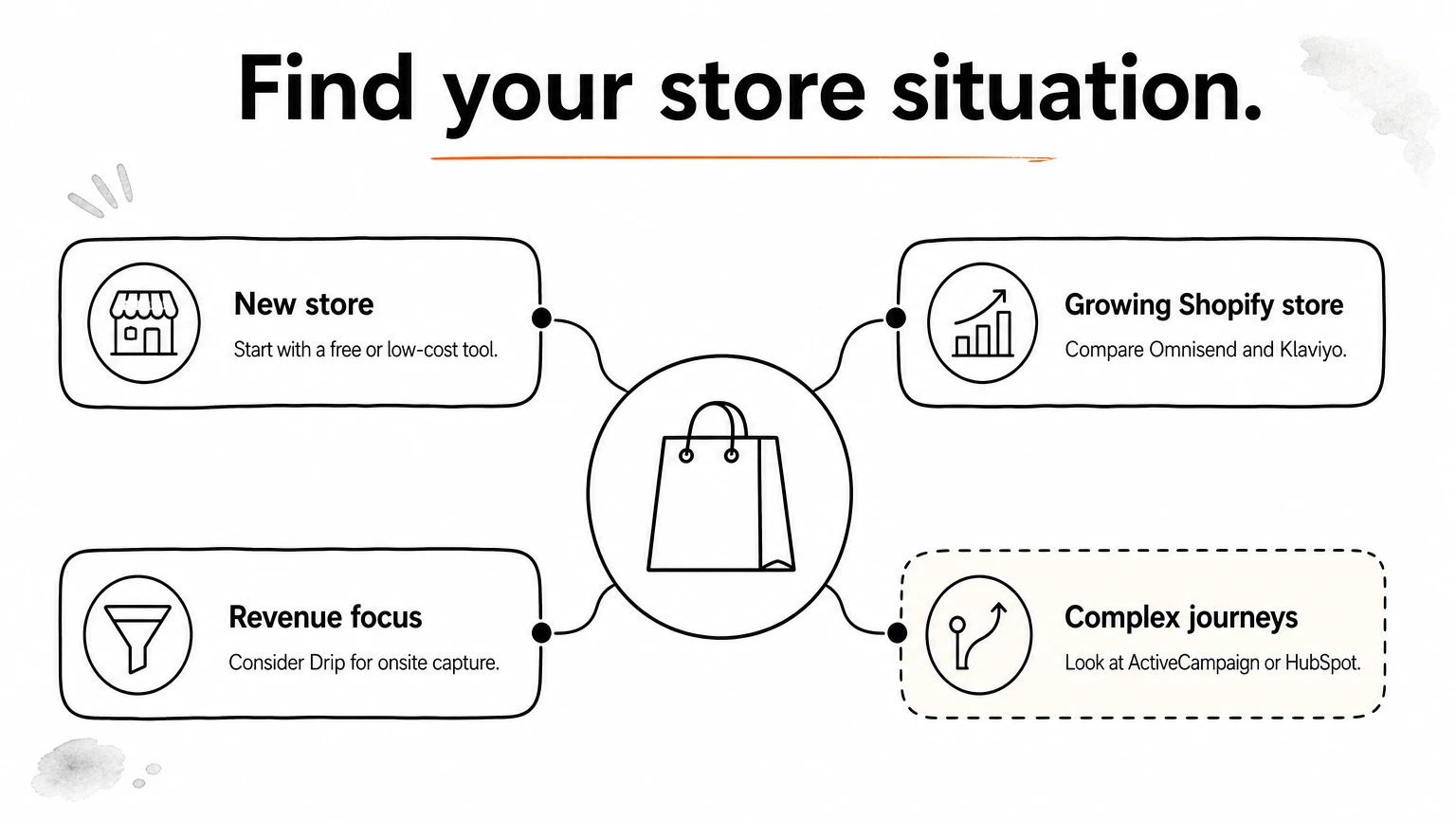
New store, under 1,000 subscribers: Shopify Email, MailerLite, or the Omnisend free plan
Growing Shopify or WooCommerce store: Omnisend or Klaviyo
Revenue and onsite capture focus: Drip
Complex journeys or B2B sales: ActiveCampaign or HubSpot
Large list, light sending: Brevo, for its send-based billing
Courses, launches, or webinars: GetResponse
When software alone is not enough
A platform gives you the engine, but flows, segmentation, creative, and testing decide your results. Many stores buy a strong tool, set up two flows, and wonder why email stays under 10% of revenue. The gap is almost always strategy and execution, not features.
That is where an ecommerce email marketing agency earns its place. A good one audits your deliverability, builds the core flows, runs campaigns on a calendar, and tests every part of the system. If you lack in-house bandwidth, pair your platform choice with someone who builds and optimizes in it daily.
Pick the tool, then build the system
For most stores, the shortlist comes down to Omnisend for balanced value, Klaviyo for data depth, and Drip for revenue focus, with MailerLite, Brevo, or Shopify Email as budget starts. Choose on store integration, pricing at your future list size, and the flows you need first.
Then remember the tool is half the work. If you want email and SMS to become a real revenue channel without hiring in-house, talk to Chromex Marketing about an audit, flow build-out, and ongoing optimization on the platform you choose.