The best email marketing firm for you has already run programs for stores like yours, works inside your email platform, and ties its fee to revenue instead of hours. Chromex is the closest fit here for ecommerce brands that want a done-for-you program with performance-based pricing. CodeCrew and InboxArmy suit brands that want a bigger team. BMO Media suits retention-focused DTC brands. DOE Media and Sweat Pants Agency suit brands that want paid media bundled in. Enflow Digital suits small stores, and Invisible Brands suits fashion brands that launch limited drops.
Choosing is hard because almost every agency promises the same thing: more revenue from your list. Their sites rarely show prices, their case studies show only the wins, and a bad hire costs you months of missing flows, weak deliverability and lost sales. You need a way to separate firms that run programs from firms that only send campaigns.
This article covers eight email marketing agencies. For each one you get what it does, who it fits and how it prices. Then you get a side-by-side table, a breakdown of what firms charge with a worked example, and a checklist for choosing. Chromex is our agency, so it goes first and we judge it by the same criteria as the rest. The figures for other firms are what they publish about themselves, so verify them on a call.
1. Chromex: done-for-you email and SMS for ecommerce
What it does
Chromex is an email and SMS marketing agency built for ecommerce brands. Farhan Uz Zaman founded it in 2021, and it runs as a lean team of email marketers, designers and strategists. It works on major platforms, including Klaviyo and Omnisend, and it is an official Omnisend partner.
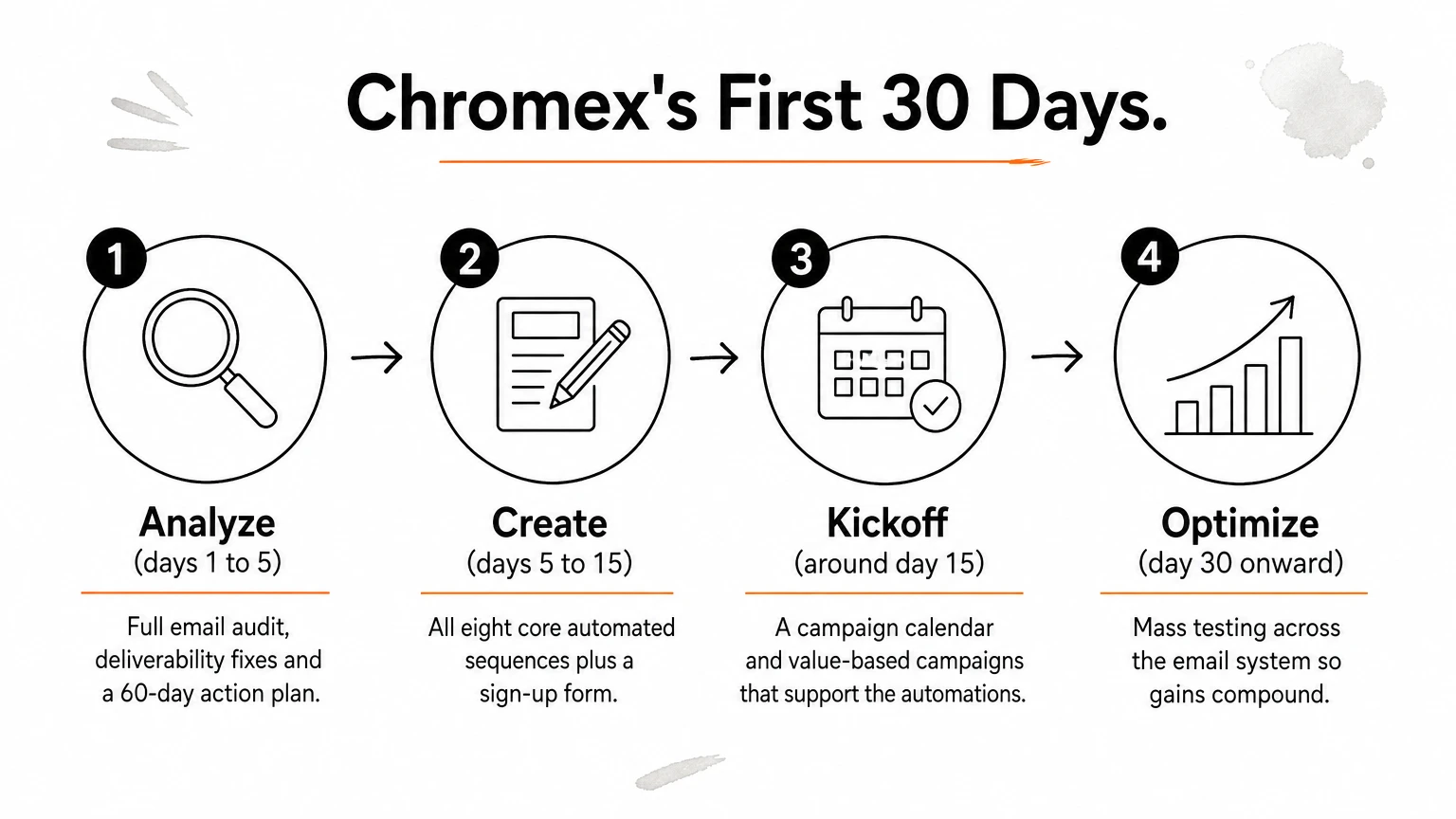
Its work follows a fixed four-step process:
Analyze (days 1 to 5): a full email audit, deliverability fixes, market and competitor insights, and a 60-day action plan.
Create (days 5 to 15): all 8 core automated sequences, plus a high-converting sign-up form for list growth.
Kickoff (around day 15): a campaign calendar and value-based campaigns that support the automations.
Optimize (day 30 onward): mass testing on every part of the email system, so gains compound.
Every email is designed from scratch with no templates, and results are reported in plain language instead of dashboard jargon.
A firm that publishes its first 30 days is easier to hold accountable than one that sells a vague retainer.
Who it suits
Chromex suits ecommerce and direct-to-consumer brands that already get traffic and spend on ads but leave their list underused. The typical client has email at under 10% of revenue and wants it at 30 to 60%. Chromex says email drives an average of 45% of its clients' monthly revenue. It also reports $14M+ in email-attributed revenue, 335M+ emails and SMS sent, and 92% client retention.
One case study shows $500,000+ generated for a brand, with email driving nearly 70% of its monthly revenue. More than 50 founders trust the agency with their programs.
The trade-off is scope. Chromex works only with ecommerce brands, so a software company or a B2B services firm should look at the general agencies below. A lean team also means fewer people than agencies like InboxArmy.
Pricing and how to start
Chromex prices on a transparent, performance-based model instead of fixed packages, so the fee follows what you get. You start by booking a call through the scheduling link on its website.
If you run Omnisend, sign-ups through Chromex's link get 20% off the first 2 months, offered as cashback. Before you sign, ask exactly which metric "performance" refers to and how attribution is measured. That question applies to every firm on this list.
2. CodeCrew: dedicated teams and custom coding
What it does
CodeCrew is a US email and SMS agency with about 38 employees. It assigns a dedicated team to each client and builds a custom email program around that client's KPIs. It was founded by marketers and designers, and it is a certified Klaviyo partner while staying open to other platforms.
Services it lists:
Email and SMS strategy
Custom design and coding
Performance tracking and reporting
Deliverability work
Ongoing email program management
Who it suits
CodeCrew suits brands that want hand-coded, custom email design and a stable team, without changing platforms. Because it is ESP-agnostic, you can keep the tool you already use. Its client list includes Nextdoor, Paint Nite, Great Jones Goods, DYPER and Focus Camera.
The agency says it delivers an average ROI above 1,300% and holds a 5.0 Google rating. Ask how it calculates that ROI and over what period. A dedicated team is a real advantage, but confirm who exactly sits on yours.
Pricing and how to start
CodeCrew does not publish packages. Its sales team writes a custom bid for each project, and a free consultation is available on its website.
When you request the bid, ask whether design, SMS and deliverability work sit inside one fee or come as add-ons. Splitting them is how quotes from different firms end up looking incomparable.
3. InboxArmy: a large bench across many platforms
What it does
InboxArmy is a US full-service email agency with 51 to 200 employees. It has operated since 2016 and says it has served more than 5,000 brands across 25-plus industries. Its team includes 120-plus email marketers certified in more than 40 email service providers.

Its service menu:
Email and SMS strategy and campaign management
Template design and coding
Email marketing automation
ESP vendor evaluation and migration
Deliverability services
Who it suits
InboxArmy suits brands that are switching email platforms or sit on a less common one. Few agencies list ESP evaluation and migration as a core service, and a firm certified across dozens of tools can give a fairly neutral view on whether to move.
Size cuts both ways. A big bench covers many needs, but a smaller brand can end up as one account among thousands. Ask who will manage your account and how many other accounts they handle.
Pricing and how to start
Pricing is custom. InboxArmy tailors it to each client's needs and business goals, and it lists no public packages.
For a migration, ask for a fixed price on the migration itself, separate from ongoing management. Migrations have a clear end date, so they should have a clear price.
4. BMO Media: lifecycle and retention for DTC brands
What it does
BMO Media is a Los Angeles-based retention marketing agency for ecommerce and direct-to-consumer brands. Its focus is lifecycle marketing: email programs that follow a customer from first purchase through repeat orders. It builds personalized experiences through automation, segmentation and copywriting.
The agency lists strength in complex automation architecture and personalized customer journeys. Its team falls in the 11 to 50 range.
Who it suits
BMO Media suits DTC brands with repeat-purchase products, where customer lifetime value matters more than any single campaign. It states that its strategies aim to lift lifetime value and lower acquisition costs, which is the right goal for a store that pays heavily for each new customer.
It is narrower than a general agency, and that is the point. If your products sell once and rarely come back, a retention specialist has less to work with. A fair test is to ask for its plan for a store with your reorder rate.
Pricing and how to start
BMO Media lists no fixed pricing plans. It offers tailored pricing based on your project and needs, so you have to ask for a quote.
When you do, ask how the fee changes as your list grows. Retention work gets more complex as segments multiply, and you want to know the price of that complexity up front.
5. DOE Media: email plus paid media and SEO
What it does
DOE Media is a US agency with 51 to 200 employees, founded in 2018. Lifecycle email is a core service. It also sells paid social, paid search, website design and development, and SEO. It offers a free digital marketing audit.
Its distinguishing claim is an EBITDA-driven approach. It says it optimizes for bottom-line profitability instead of vanity metrics such as open rates. Its named clients include Katzkin, Power Crunch, Engine, Triller and AliExpress.
Who it suits
DOE Media suits brands that want one agency across several channels and care about profit, not just revenue. If your email, ads and site are all underperforming, one team can coordinate them instead of three vendors pointing at each other.
The cost of breadth is focus. In a multi-channel agency, email is one service line among several, so check how much of the team's time goes to your lifecycle program. Ask who owns email day to day.
Pricing and how to start
DOE Media customizes pricing to each client. It publishes no packages, but the free audit gives you a concrete document before any commitment.
Use that audit as a test. If it names specific gaps in your flows, deliverability and list growth, the firm is paying attention. If it reads like a generic checklist, treat that as a signal.
6. Sweat Pants Agency: email, SMS and ads for fast growers
What it does
Sweat Pants Agency is a US agency with 11 to 50 employees. It sells email and SMS marketing alongside Meta, Google, LinkedIn and TikTok advertising and creative services. It is a Meta Premium Partner.
It says it has sent more than 4.3 billion emails and 147 million SMS messages. Its founders say they built two companies that ranked first on the Inc. 500 list of fastest-growing companies.
Who it suits
Sweat Pants Agency suits fast-growing brands that want ads and lifecycle under one roof. When paid social brings traffic and email converts it, putting both with one team keeps messaging consistent from ad to inbox.
As with any multi-channel shop, check where the email expertise sits. Ask to meet the person who will build your flows, and ask how many email accounts that person manages. Growth claims from the founders' earlier companies tell you about ambition, not about your account.
Pricing and how to start
The agency does not publish pricing. It does offer a free marketing plan to get you started, which lets you judge its thinking before you talk numbers.
Ask whether ad management and email are priced together or separately. A bundled fee can hide how much each channel costs you.
7. Enflow Digital: a small ecommerce specialist
What it does
Enflow Digital focuses on ecommerce email and SMS. It is based in Lithuania, has 2 to 10 employees, and was founded in 2022. It helps clients set up and manage their email service provider accounts. It also runs email and SMS audits and strategy, A/B and split testing, and deliverability recovery.
It is a certified partner of several marketing platforms, Omnisend among them. It says it has generated more than $30 million in email revenue for clients.
Who it suits
Enflow suits small and early-stage online stores that want hands-on attention from a specialist team, especially stores running Omnisend. A tiny agency can give a small account real focus, and deliverability recovery matters if your sender reputation is already damaged.
The trade-offs are capacity and time. A team of 2 to 10 can only carry so many accounts, and the firm is newer than most here. Its base is several hours ahead of the US East Coast, so agree on call windows before you start.
Pricing and how to start
Enflow does not publish its pricing. It offers a free strategy session, which is the natural first step.
Use the session to test depth. Ask what it would fix first in your account and why. A specific answer in the first call is worth more than any case study.
8. Invisible Brands: DTC fashion and drop launches
What it does
Invisible Brands is a German email and SMS agency with 11 to 50 employees, founded in 2020. It covers strategy, copywriting, design, setup and optimization. It says it serves more than 25 ecommerce brands across Germany, Australia and the United States.

It stresses transparency: it shares insights and performance metrics with clients so both sides stay aligned on goals.
Who it suits
Invisible Brands suits direct-to-consumer fashion brands and brands that launch limited product drops. Drops need tight timing, a warmed-up list and urgent copy, and that is a different skill from steady evergreen flows.
If you run a standard catalog store with no drops, the specialization matters less. Check the time zone too, because the team works from Germany and a US store needs overlap for launch weeks.
Pricing and how to start
The agency publishes no specific pricing. You contact its sales team to discuss custom options.
Ask how it prices a drop launch compared with ongoing flows. Launch work is bursty, so a flat monthly fee may not fit it.
Email marketing firms compared side by side
The comparison table
This table puts the eight firms next to each other on the points that usually decide a shortlist. Team sizes and services come from each firm's public description.
Firm | Team size | Channels | Pricing | Strongest fit |
|---|---|---|---|---|
Chromex | Lean team | Email and SMS | Performance-based, no fixed packages | Ecommerce brands that want a done-for-you program |
CodeCrew | About 38 | Email and SMS | Custom bids, free consultation | Custom design and coding with a dedicated team |
InboxArmy | 51 to 200 | Email and SMS | Custom | Platform migrations and uncommon ESPs |
BMO Media | 11 to 50 | Email and lifecycle | Tailored | DTC retention and repeat purchase |
DOE Media | 51 to 200 | Email, paid media, SEO, web | Custom, free audit | Profit-focused multi-channel growth |
Sweat Pants Agency | 11 to 50 | Email, SMS, paid ads | Not published, free marketing plan | Fast-growing brands that need ads too |
Enflow Digital | 2 to 10 | Email and SMS | Not published, free strategy session | Small ecommerce stores |
Invisible Brands | 11 to 50 | Email and SMS | Not published | DTC fashion and drop launches |
What the table tells you
Three patterns stand out. Team size ranges from 2 to over 100, and it shapes how much attention your account gets. Channel mix splits the list into email specialists and multi-channel shops. And none of the eight publishes a price list, so you compare firms by the scope of each quote instead of by a sticker price.
Use that last point to your advantage. Send the same brief to three firms, including your platform, list size, send frequency and revenue goal. Quotes built on identical inputs are far easier to compare.
Because no firm posts prices, the fairest comparison is three quotes written against the same brief.
What email marketing firms charge
Typical price ranges
Most email marketing agencies quote by custom proposal, and the spread is wide. A commonly cited range puts small-business engagements at roughly $200 to $900 a month and mid-sized to larger programs at $4,000 to $20,000 or more a month. Treat those as rough bands, not rate cards.
The gap exists because scope differs. A thin retainer might cover a few campaigns, while a full program covers flows, campaigns, design, testing and deliverability. Five factors move the price most:
Size of your list and monthly send volume
Number of campaigns per month
Number of automated flows to build and maintain
Custom design versus reused layouts
Whether SMS is included
Platform subscriptions such as Klaviyo or Omnisend are normally billed separately from the agency fee, so ask what your all-in monthly spend will be.
Price follows scope, so compare quotes by what each one includes, not by the monthly number.
Pricing models compared
Firms usually charge in one of three ways. Each rewards a different behavior, so pick the one that matches your risk tolerance.
Model | How it works | Best for | Watch for |
|---|---|---|---|
Monthly retainer | Flat fee for an agreed scope | Ongoing programs with steady volume | Paying for activity instead of results |
Project-based | One-off fee for an audit or flow build | Fixing one specific gap | No testing after handoff |
Performance-based | Fee tied to revenue or other results | Brands that want aligned incentives | Attribution rules must be written down |
A worked example: does the fee pay for itself?
Take a store with $100,000 in monthly revenue and email at 8% of it, or $8,000. If email reaches 30%, it brings in $30,000, a gain of $22,000. Not all of that is new money, because some of it moves over from other channels. Assume half is truly incremental: $11,000.
Now compare that with a $5,000 monthly fee, which sits inside the mid-sized range above. At a 50% gross margin, the agency must add $10,000 in incremental revenue just to break even ($5,000 ÷ 0.5). Your $11,000 clears that with about $500 a month to spare, and the gain grows as your base grows.
Run the same numbers for a $40,000-a-month store. Email goes from $3,200 to $12,000, a gain of $8,800, and half of that is $4,400. At 50% margin that is $2,200 of gross profit against a $5,000 fee, so the agency does not pay for itself. A smaller store should start with a lighter engagement or an audit-and-build project.
How to choose an email marketing firm
Six criteria that separate good firms from filler
Judge every firm on the same six points, and write the answers down.
Specialization. Ask how many of its clients sell what you sell. An ecommerce specialist knows abandoned-cart and post-purchase timing, while a generalist may know neither.
Platform expertise. The firm should work in your tool, or give a clear reason to move. Certifications help, but ask for examples of what they built on that platform.
A stated process. You should be able to describe the first 30 days in a sentence. If the firm cannot, you are buying a retainer, not a plan.
Reporting you can read. Ask for a sample report. It should show revenue and its drivers in plain language, not a wall of open-rate charts.
Pricing clarity. Know the fee, what is excluded, and how it changes as your list grows.
Proof with context. A revenue lift means little without the starting point. Ask what share of revenue email represented before and after.
Agency, freelancer or in-house
Agency email marketing is not the only route, and it is not always the right one. Compare the three options on what they actually give you.
Option | Strengths | Weaknesses | Fits |
|---|---|---|---|
Agency | A team covering strategy, design, development and deliverability; a tested process | Higher cost; less direct control day to day | Brands where email already earns meaningful revenue |
Freelancer | Lower cost; flexible | One person rarely covers every skill; capacity and continuity risk | Small lists and narrow, defined tasks |
In-house hire | Full control; deep brand knowledge | Salary, tooling, and a slow learning curve | Large programs with constant send volume |
An agency usually pays off when you send often, your list is large, or email carries a real share of revenue. If you only send an occasional newsletter to a small list, handle it yourself first and bring in a firm once you outgrow it.
Questions to ask on the first call
Good questions expose weak firms quickly. Bring these:
Which platforms do you work on, and which would you recommend for my store?
Who will work on my account, and how many other accounts do they handle?
What happens in the first 30 days?
How do you measure results, and which attribution window do you use?
Can you show email's share of revenue before and after for a store like mine?
What is not included in the fee, such as design, SMS or platform costs?
How do we end the contract, and who owns the flows and designs afterward?
Red flags to walk away from
Walk away from any firm that guarantees a specific revenue number before seeing your data. Be wary of agencies that skip the audit and go straight to sending, since the audit is where deliverability problems and missing flows get found. Reused templates with a logo swap, vague answers about who does the work, and long lock-in terms with no performance review are also warning signs.
The strongest signal in a first call is how specific the firm gets about your account.
Picking the right firm for your store
Every firm on this list can run campaigns. The difference is fit: the right specialization, a named platform, a clear process and a fee you can measure against revenue. Match the firm to your store type, send three firms the same brief, and use the first-call questions above to compare their answers.
If you run an ecommerce or DTC brand and want email and SMS to carry a bigger share of revenue, start with the audit-first approach. Book a call with Chromex to see what a 60-day action plan looks like for your store.