Ecommerce email marketing is the use of email to turn online shoppers into buyers and buyers into repeat customers. It has two parts. Automated flows send a message when a shopper does something, such as joining your list, abandoning a cart or placing an order. Scheduled campaigns send a sale, a launch or a story to a chosen segment at a time you pick. The list belongs to you, so reaching a shopper again costs a fraction of buying that click a second time.
This guide covers why the channel matters, how to build a strategy in the right order, and which automated flows earn the most, starting with abandoned cart emails. It also covers campaigns, sign-up forms, measurement, deliverability, tools and a few advanced tactics. The principles work for any online store, whether it runs on Shopify or another platform.
We know this work firsthand. Chromex has run email and SMS for ecommerce brands since 2021 and has sent more than 335 million messages. The advice below comes from running programs, not from theory.
Why ecommerce email marketing matters for your store
Email matters because it is the one sales channel you own. It reaches shoppers who have already shown interest, and it keeps producing revenue without a new ad bill for every visit. For an online store, that makes it the cheapest route to more repeat purchases.
You own the list, and ads do not give you that
Paid ads and social platforms rent you attention. Prices rise, algorithms change, and an account can be limited overnight. Email is different. An email list is an owned audience, and you decide what it hears and when.
Consider what happens to the traffic you already pay for. Most visitors leave without buying. Without an email address, that click is gone. With one, you can follow up at almost no marginal cost, which is why email recovers value from ad spend you have already made. So yes, email marketing is still worth it. It remains one of the few channels where a small team can out-earn its cost many times over.
Email turns visitors you already paid for into customers you can reach again for free.
What results to expect
Automation does most of the heavy lifting. Omnisend's 2026 ecommerce report found that automated emails produced 30% of email revenue from only 2% of sends. Across Chromex client programs, email drives an average of 45% of monthly revenue. One brand we worked with generated $500,000+ from email, which drove nearly 70% of its monthly revenue. Those are mature programs. Stores that are just starting often see email contribute under 10%.
Here is what the gap means in dollars. Take a store that earns $100,000 a month. At 10% email share, email accounts for $10,000. At 30%, it accounts for $30,000. That is not all new money, since some of those buyers would have returned anyway, but it shows why the share of revenue is a better goal than open rate.
Flows and campaigns do different jobs
The two mechanisms behind ecommerce email marketing work differently, and you need both. Flows run in the background all day. Campaigns are the moments you control.
Automated flows | Scheduled campaigns | |
|---|---|---|
Trigger | A shopper action or date | Your calendar |
Examples | Welcome, abandoned cart, winback | Sales, launches, seasonal sends |
Effort | Build once, refine often | Produce every send |
Main job | Capture intent and build habit | Create demand at chosen moments |
Flows catch revenue that would otherwise leak away. Campaigns give flows more people to work on and give customers a reason to return between orders.
How to build an ecommerce email marketing strategy
Build the strategy in a fixed order: set a revenue goal, audit what you have, fix deliverability, build the core flows, then add campaigns and testing. Stores that jump straight to weekly campaigns usually plateau, because the flows that earn the most per send are still missing.
Set a revenue goal and audit what you have
Start with a number tied to revenue, not opens. "Move email from 10% to 30% of store revenue in six months" works. "Improve engagement" does not. A good goal gives every later decision a test: does this move the number?
Then audit your current setup. A common finding is a single welcome email and a basic cart reminder, with nothing after the first purchase. Check each of these:
Which flows exist, and whether they are live and sending
How many subscribers opened or clicked in the last 90 days
Where sign-ups come from and what each form converts
Whether SPF, DKIM and DMARC are set up on your sending domain
How you segment, if at all
A 60-day order of operations
You can run the rollout in four stages. Chromex calls them Analyze, Create, Kickoff and Optimize, and the sequence works even if you do it in-house. Each stage supplies what the next one needs.
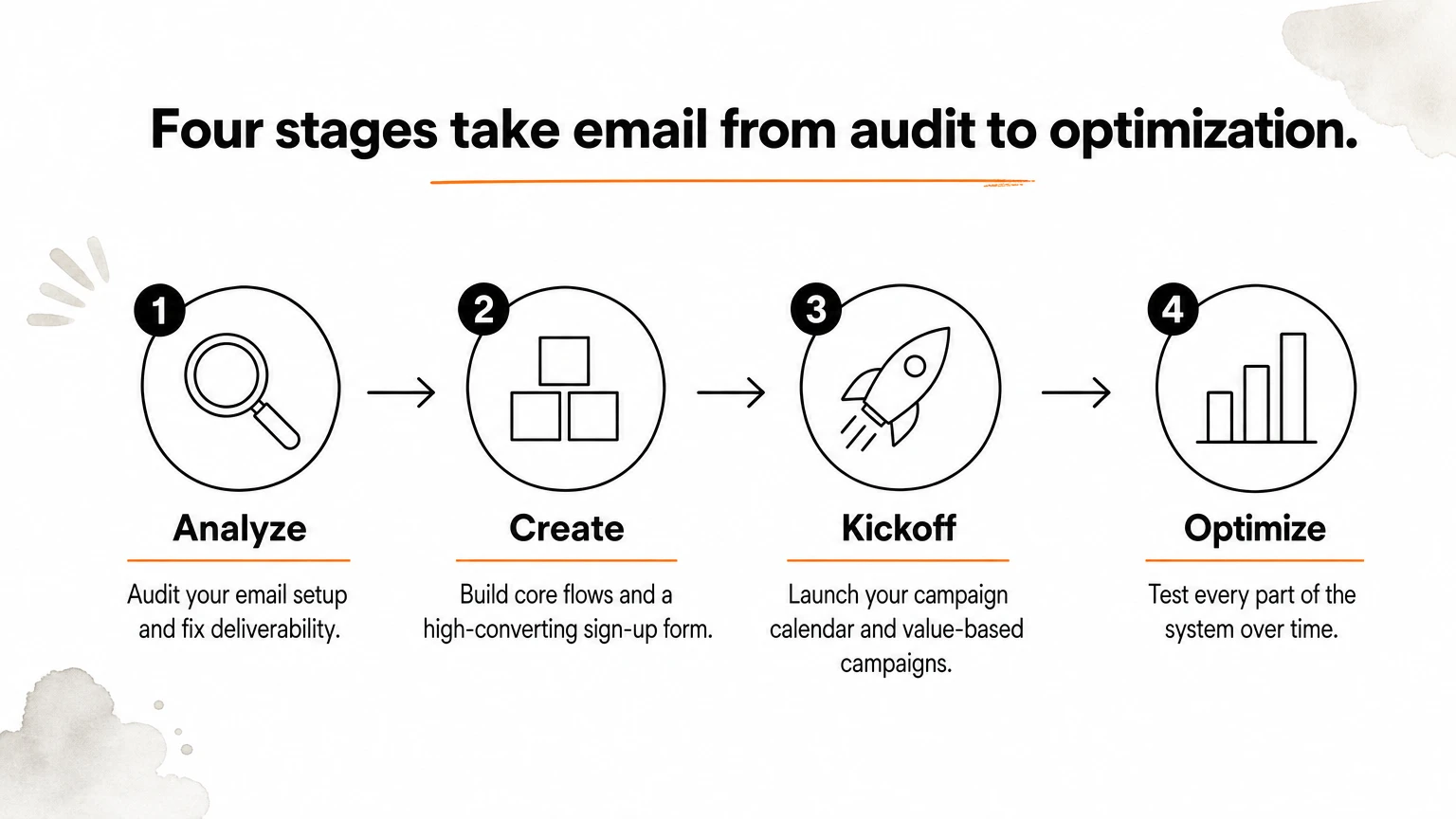
Days | Stage | What happens |
|---|---|---|
1 to 5 | Analyze | Full email audit, deliverability fixes, competitor insights, 60-day action plan |
5 to 15 | Create | Core automated flows and a high-converting sign-up form |
Around 15 | Kickoff | Campaign calendar and value-based campaigns that support the flows |
30 onward | Optimize | Ongoing testing of every part of the system |
Flows come before campaigns because they work on your existing traffic from day one. Testing comes last because you need volume and a stable baseline before results mean anything.
Fix deliverability, then build flows, then send campaigns. Reversing that order wastes your best sends.
Automated flows that drive repeat sales
The core flows to build first are welcome, abandoned cart, browse abandonment, post-purchase, winback and back-in-stock, followed by loyalty. They respond to shopper intent, which is why a single flow email often earns more than a whole campaign. This table puts the timing and goal of each in one place.
Flow | Trigger | Typical timing | Goal |
|---|---|---|---|
Welcome series | Sign-up | Immediately, then days 1 to 3 | First purchase |
Abandoned cart | Checkout started, cart left | 1 hour, 24 hours, 72 hours | Recover the sale |
Browse abandonment | Product viewed, no cart | A few hours later | Re-engage interested shoppers |
Post-purchase | Order placed, then delivered | Immediately, then days after delivery | Reviews and a second order |
Cross-sell | Purchase or browsing history | 3 to 7 days after an order | Higher order value |
Winback | No purchase in 60 to 90 days | Day 60, then day 90 | Reactivate lapsed buyers |
Back-in-stock | Sold-out item returns | Immediately | Capture proven demand |
Loyalty and birthday | Milestone or date | On the date | Lifetime value |
Abandoned cart emails
An abandoned cart flow is the highest-intent flow you will build, because the shopper already chose the product. Send three emails: the first about an hour after the cart is left, the second at 24 hours, the third at 72 hours. Show the exact cart contents with images and a one-click link back to checkout.
Use each email for a different job. Email one is a plain reminder with no discount. Email two answers objections: reviews, shipping times, returns policy. Hold any incentive for email three, and only if your margin allows it. Otherwise use honest low-stock language. Subject lines that work in practice are short and specific, such as "You left something behind" or "Still thinking about the [product]?"
A worked example shows the stakes. Assume 2,000 carts are abandoned in a month. If the three-email flow recovers 8% of them, that is 160 orders. At a $70 average order value, the flow returns $11,200 a month, and it runs without anyone pressing send. Your recovery rate will differ, so treat the figures as a way to size your own opportunity.
Welcome series and browse abandonment
The welcome series has the best odds of converting a new subscriber, because interest peaks at sign-up. Send the first email within minutes, then two more over the next few days. Open with who you are and your best sellers, then present the offer in the second or third email with a clear deadline, such as seven days.
Browse abandonment catches shoppers who looked at a product but never added it to the cart. It is a lighter touch than a cart reminder. Show the product they viewed and two close alternatives, and skip the discount.
Post-purchase, winback and back-in-stock
The post-purchase flow starts the moment the order is placed. Order and shipping emails are read at high rates, so use them to set expectations and add two or three complementary products. After delivery, ask for a review, then send a cross-sell tied to what they actually bought.
Winback starts when a customer passes their normal buying window, often 60 to 90 days. Lead with new products or a useful reminder, and save the incentive for the later emails. If nobody responds after three, stop mailing them. Back-in-stock alerts are simple and very effective, since the shopper asked for the item. Send them the moment inventory updates, and let the sign-up data guide your reorders.
The best flows act on a shopper's last action, so build around behavior, not the calendar.
Campaigns, segments and sign-up forms
Campaigns work best when they go to segments you built from real behavior, and when a good sign-up form keeps feeding the list. Treat the three as one system: forms grow the list, segments decide who gets what, and campaigns create demand around the flows.
Sign-up forms and list growth
A sign-up form is the front door to your email marketing for an ecommerce website, so build more than one. Pop-ups and full landing pages consistently outperform a form buried in the footer. Omnisend's benchmarks put landing pages near 6.5%, pop-ups near 3.8% and embedded forms near 1.3%. Trigger a pop-up after 5 to 10 seconds or about half a page of scrolling, not the instant someone arrives.
Keep the first step to an email address, then collect preferences afterward. A short quiz or a "what are you shopping for?" question gives you data for segmentation later. Use double opt-in if list quality matters more than raw size, since it confirms real addresses and protects your sender reputation.
Segments that make messages relevant
Segmentation is how one list becomes several useful audiences. Start with lifecycle stage and purchase behavior, and add more only when you can act on them.
Segment | Message | Goal |
|---|---|---|
New subscribers | Welcome series | First purchase |
First-time buyers | Product tips, cross-sells | Second order |
Repeat customers | Recommendations, early access | Higher order value |
VIP high spenders | Rewards, previews | Retention |
Inactive 60 to 90 days | Winback sequence | Reactivation or list cleanup |
The familiar 80/20 rule often applies here. A minority of customers, often around 20%, tends to produce most of your revenue. Check your own numbers, then give that group its own treatment.
Campaigns that support the flows
Four campaign types cover most stores: promotions with a deadline, product launches, educational or brand content, and seasonal sends. Plan them on a calendar that leaves room for your flows, and start with one or two a week. Let your unsubscribe and complaint rates tell you if you are pushing too hard.
Design carries more weight than most people expect. Use a single-column layout, body text of at least 16px and large tappable buttons, and preview every send in dark mode. Visuals tailored to your brand stand out in the inbox far better than a stock template, which is why Chromex designs every email without templates.
Segment first and send second, because relevance beats volume every time.
How to measure results and protect deliverability
Measure revenue, not clicks, and protect the sender reputation that decides whether your emails reach the inbox. Both matter, because a flawless strategy produces nothing if Gmail routes it to spam.
Metrics that show real results
Revenue per recipient is the cleanest single metric: total email revenue divided by delivered emails. If you send 40,000 emails in a month and attribute $6,000 to them, your revenue per recipient is $0.15. Track it separately for flows and campaigns, because flows usually beat campaigns by a wide margin.
Metric | What it tells you | How to read it |
|---|---|---|
Revenue per recipient | Money earned per delivered email | Your main scorecard |
Placed order rate | Share of delivered emails that led to orders | Compare flows with campaigns |
Conversion rate | Orders per click or per send | Test offers and pages |
Unsubscribe and complaint rate | Whether you are sending too much or the wrong thing | Watch for spikes |
Open rate | Rough subject line appeal | Diagnostic only |
Open rates are unreliable. Apple Mail Privacy Protection can load a message automatically and count it as an opened email, which inflates the figure. Use opens to spot a sudden drop, not to judge success.
Deliverability basics
Deliverability comes down to authentication, list quality and engagement. Authenticate your sending domain with SPF, DKIM and DMARC. Gmail and Yahoo expect that from bulk senders, along with easy unsubscribing and a low spam complaint rate. Google publishes its email sender guidelines with the current thresholds.
Keep the list healthy by suppressing contacts who have not engaged in 60 to 90 days, after one last winback attempt. In the United States, the CAN-SPAM Act requires an accurate sender identity, a physical address and a working opt-out. If you sell to customers in Europe, the GDPR adds explicit consent rules.
Testing without fooling yourself
Test one variable at a time: a subject line, a send delay, an offer or a call to action. Keep a control group, and run the test long enough to gather a meaningful sample. Judge winners by revenue per recipient or conversion, not by clicks alone. Record every result so the next test builds on the last one. This is the compounding work that separates a flat program from a growing one.
Judge every test by revenue, because a winning subject line that sells nothing is not a winner.
Tools and advanced tactics to add next
Choose a platform that syncs natively with your store, then add advanced tactics only after the core flows are stable. The best ecommerce email marketing setup is the simplest one that your team will run consistently.
Choosing an email platform
Look for native store sync, prebuilt flows, dynamic product blocks, flexible segmentation and, if you plan to use it, SMS in the same tool. Klaviyo, Omnisend, Mailchimp and ActiveCampaign are the email marketing software names most ecommerce stores shortlist. Chromex works across the major platforms and is an official Omnisend partner.
On cost, platforms usually price by contact count or profiles rather than by individual sends. Entry plans for small lists typically run from roughly $10 to $20 a month, and several offer free tiers for a few hundred contacts. Sending 1,000 emails is therefore rarely the cost driver. List size and features are. Confirm current pricing on each vendor's page before you decide.
Advanced tactics worth adding
Once flows and campaigns are running, these tactics add the next layer of revenue:
Zero-party data: quizzes and preference questions let customers tell you what they want, which sharpens every segment.
RFM segmentation: group buyers by recency, frequency and monetary value, then give your best customers early access and rewards.
Predicted reorder timing: for consumables, send a replenishment email just before the customer runs out.
Smart suppression: exclude recent purchasers from promotions and exclude owned products from recommendations.
SMS alongside email: use text for time-sensitive messages like flash sales and restocks, and keep email for richer storytelling.
Send-time optimization: let the platform choose a send time per subscriber, then verify the lift with a holdout group.
Add one at a time and measure it against a baseline, so you know which change actually moved revenue.
Where to go from here
Ecommerce email marketing works because it combines an owned audience with messages triggered by what shoppers actually do. Set a revenue goal, audit your setup, and build the core flows before you send a single extra campaign. Add segments, strong sign-up forms and steady testing, measure by revenue per recipient, and guard your deliverability so the work reaches the inbox.
If you would rather hand the build and the testing to a team that does this every day, talk to Chromex about running email and SMS for your store. Either way, start with the abandoned cart flow this week.