ActiveCampaign vs Omnisend comes down to what you sell. Omnisend is the better pick for most online stores. It has ecommerce tools built in, sends email, SMS and web push from one workflow, offers a free plan, and costs less as your list grows. ActiveCampaign is the better pick for B2B and service businesses, and for teams that want a built-in CRM and deeper automation logic and can live with a steeper learning curve.
Both platforms promise automation, segmentation and SMS, so their feature pages look almost identical. The differences show up in the details. Which features sit on which plan? How much setup does a store need before it earns revenue? What do you pay at 5,000 contacts? This comparison of Omnisend vs ActiveCampaign walks through five areas that decide the choice, with a verdict for each.
Chromex is an email and SMS agency for ecommerce brands and an official Omnisend partner, so we lean toward Omnisend for stores. We still call out every area where ActiveCampaign wins, because the wrong platform costs more than the subscription.
1. Ecommerce features and SMS
Omnisend wins on ecommerce features and SMS. It was built for online stores, while ActiveCampaign is a general marketing and CRM platform that handles ecommerce through integrations and setup work you do yourself.
How they compare
The gap shows up in how much you build from scratch. With Omnisend you connect a store such as Shopify, WooCommerce or BigCommerce and get product blocks, discount codes and pre-built ecommerce workflows ready to switch on. ActiveCampaign gives you the building blocks, but you assemble more of it yourself, and its email editor has fewer native product blocks.
Feature | ActiveCampaign | Omnisend |
|---|---|---|
Store integrations | Hundreds of apps, including Shopify | Shopify, WooCommerce, BigCommerce and more |
Product blocks in email | Limited | Product picker built in |
Ecommerce starting flows | Fewer, mostly built by you | Cart, browse, welcome and post-purchase templates |
SMS | Paid add-on | Built into the platform, billed by credits |
Channels in one workflow | Email, SMS, site messaging | Email, SMS, web push |
Who comes out ahead
Online stores should pick Omnisend here. Abandoned cart, browse abandonment and post-purchase flows start from templates, and you can mix email, SMS and push in the same flow instead of stitching channels together.
ActiveCampaign still makes sense when the store is a side of the business, such as a coaching brand that also sells a few products. Just remember that SMS costs extra there, which matters if texting is part of your plan.
Omnisend starts from the store, ActiveCampaign starts from the contact record.
2. Automation and segmentation
ActiveCampaign wins on automation depth, and Omnisend wins on how fast a store gets automations live. Both offer visual builders, conditional branching and behavior-based segments, so the choice depends on how complex your logic really is.

How they compare
ActiveCampaign treats automation as a system. You can chain small automations together, track goals, score leads and trigger sales tasks from the built-in CRM. Omnisend gives you a visual builder too, with branching on every plan, and lets you pick a goal like recovering carts or building loyalty and start from a matching template.
Capability | ActiveCampaign | Omnisend |
|---|---|---|
Workflow builder | Visual, multi-step, modular | Visual, template-led |
Conditional branching | Yes, with goal tracking | Yes, on every plan including free |
CRM and sales automation | Built in | Limited |
Segmentation | Tags, behavior, custom fields, engagement | Purchase behavior, engagement, channel preference |
Segments across channels | Email-centered, SMS on higher plans | Email, SMS and push together |
Who comes out ahead
Choose ActiveCampaign if your sales process has stages, owners and follow-ups, or if you want lead scoring and personalized content blocks. Its depth is real, but you need a plan before you build.
Most stores need less than that. Depth matters less than coverage: a store with all core flows live beats one with three elaborate ones. In the Create stage of our process (days 5 to 15), we build 8 core automated email sequences plus a sign-up form.
Pick ActiveCampaign for the most complex journeys, and Omnisend for the fastest route to a working set of flows.
3. Pricing and free plans
Omnisend costs less at almost every list size, and it has a free plan. ActiveCampaign has no free plan, only a 14-day trial, and its entry tier holds back features that Omnisend includes from the start. Prices change, so confirm current numbers on each pricing page before you commit.
How they compare
Omnisend's Free plan allows 500 emails a month and includes popups, forms, landing pages and automation. Paid plans start around $16 a month, and Pro starts around $59 a month. ActiveCampaign's entry plan starts around $15 a month but excludes landing pages and predictive sending, and the Plus tier (from roughly $49 a month) is where ecommerce integrations and fuller automation arrive.
ActiveCampaign | Omnisend | |
|---|---|---|
Free plan | No, 14-day trial | Yes, 500 emails a month |
Entry paid plan | From about $15 a month | From about $16 a month |
Higher tier | Plus from about $49 a month | Pro from about $59 a month |
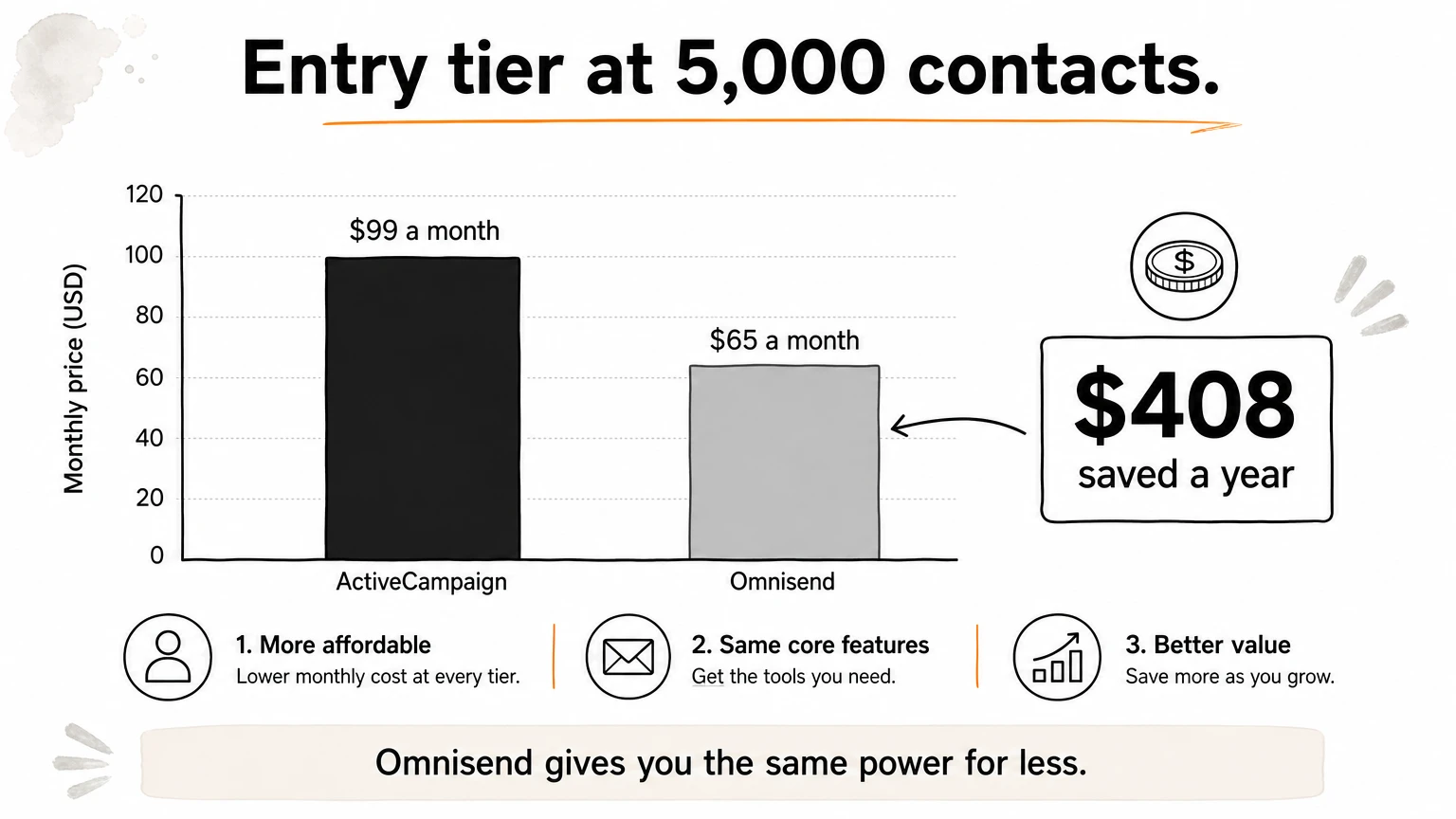
Entry tier at 5,000 contacts | About $99 a month | About $65 a month |
SMS | Extra cost | Credits on top of the plan |
A worked example
Take a store with 5,000 contacts on each platform's entry tier. At roughly $65 versus $99 a month, Omnisend saves about $34 a month, or $408 a year. That gap is before ActiveCampaign's SMS add-on, and you may need to move up a tier to get features Omnisend includes by default.
The CRM is the exception. If you would otherwise pay for a separate CRM, ActiveCampaign's higher price can be the cheaper total stack. For an online store with no sales pipeline, you would be paying for tools you never open.
At the same list size, Omnisend usually costs about a third less, and that gap compounds every month.
4. Ease of use, support and deliverability
Omnisend is easier to learn, and ActiveCampaign is generally rated a little stronger on deliverability. Neither difference should decide the purchase alone, because your own sending habits move deliverability more than the platform does.

How they compare
ActiveCampaign's interface is dense, with layers of menus and a modular approach to automations that takes a mindset shift. Omnisend walks you through connecting your store and pulls your logo, colors and fonts into emails automatically, so a first campaign goes out quickly.
ActiveCampaign | Omnisend | |
|---|---|---|
Learning curve | Steeper | Gentle |
First-campaign setup | Plan the structure first | Connect store, branding imported |
Support | Live chat and email | Live chat, email and help center |
Deliverability | Generally rated strong | Rated lower in some comparisons |
Who comes out ahead
On usability, Omnisend wins for small teams without a dedicated email specialist. ActiveCampaign rewards marketers who will invest the onboarding time, and it pays back for them.
On deliverability, ActiveCampaign gets slightly better marks, but platform choice is a smaller factor than authentication (SPF, DKIM, DMARC), list hygiene and how engaged your subscribers are. When we audit an account, deliverability fixes come before any new campaigns, because strong flows sent to the spam folder earn nothing.
Deliverability depends more on how you send than on which platform you send from.
5. Which platform fits your business
Choose Omnisend if you run an online store, and ActiveCampaign if you run a B2B or service business with a sales pipeline. Your business model settles the choice more reliably than any feature count.
How they compare
Your situation | Better pick | Why |
|---|---|---|
Shopify or WooCommerce store | Omnisend | Product blocks and ecommerce flows built in |
Want email and SMS in one tool | Omnisend | SMS is part of the platform |
Testing email before spending | Omnisend | Free plan with automation included |
B2B or service business | ActiveCampaign | Built-in CRM and lead scoring |
Long sales cycles | ActiveCampaign | Deal tracking and sales automation |
Experienced team, complex journeys | ActiveCampaign | Deeper logic and personalization |
Who comes out ahead
For ecommerce brands, Omnisend is the safer default. As an official partner, we can point you to a sign-up link that gives 20% off your first 2 months as cashback.
If you outgrow either tool, Klaviyo is the other platform ecommerce brands commonly compare. Whichever you choose, the platform is only the engine. Strategy, flows and testing produce the revenue.
If your revenue comes from product orders, start with Omnisend. If it comes from managed deals, start with ActiveCampaign.
Pick the tool that matches how you sell
Omnisend suits online stores that want ecommerce features, SMS and a low price in one place. ActiveCampaign suits businesses that need a CRM, lead scoring and deep automation, and can absorb a steeper learning curve and a higher bill. Weigh the five areas above against how you actually sell, not against feature lists.
Choosing the platform is the easy half. The harder half is building flows, designing emails and testing until email becomes a real revenue channel. If you would rather hand that to specialists, see how Chromex runs email and SMS for ecommerce brands.